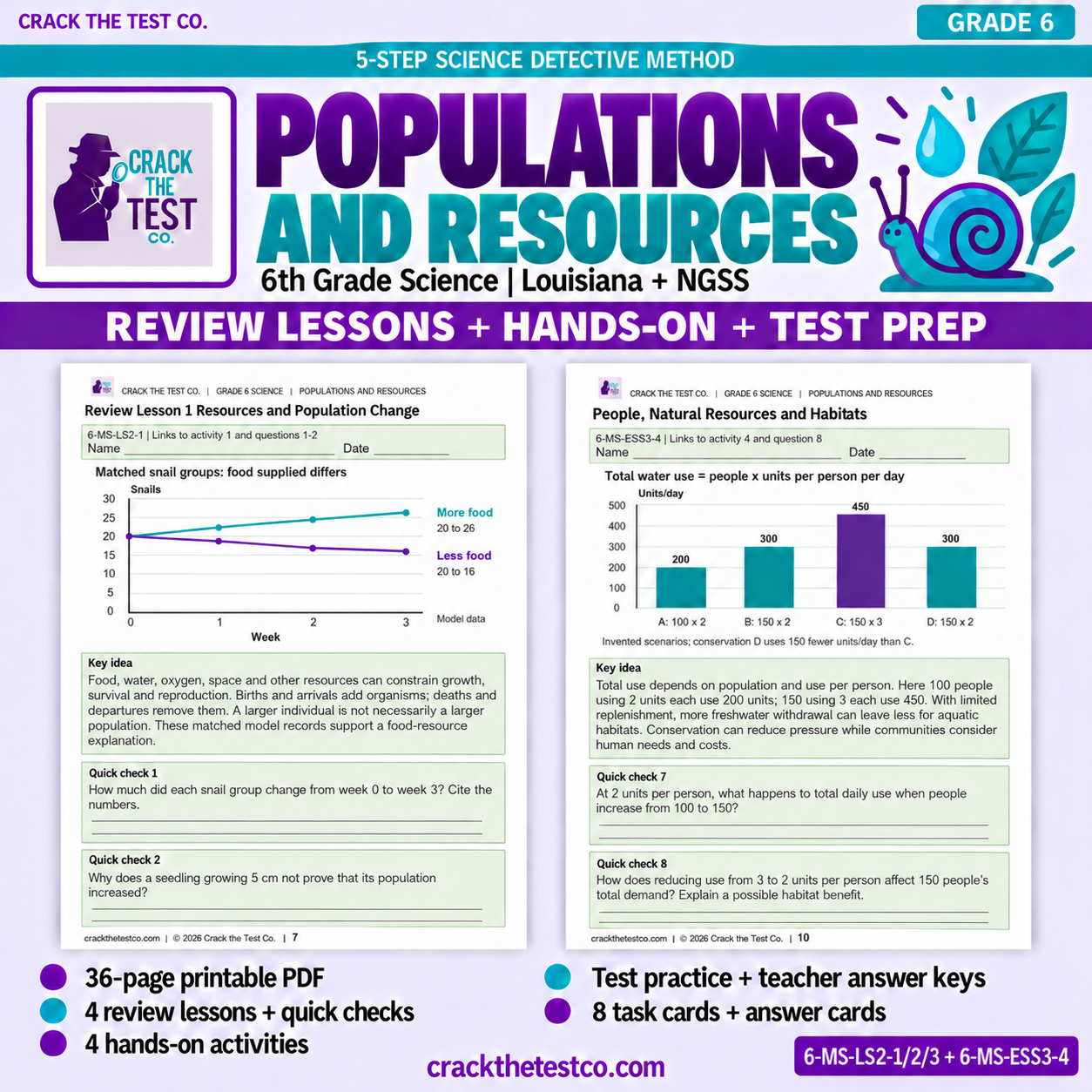
Help students explain population changes, compare interactions across ecosystems, and connect resource use with Earth systems in this 36-page printable science review. A two-page five-step teacher worked example shows how to walk students through evidence before independent test practice.
The five-step teacher model:
Model Read, Annotate, Find evidence, Analyze, and Eliminate and justify. Teacher prompts show what to say and mark, how to calculate population changes, connect resources with survival and reproduction, and explain each eliminated choice. A guided transfer distinguishes individual seedling growth from population growth.
Four review lessons before test prep:
Eight quick checks help teachers check understanding of the targeted standards before test prep to improve student success. Illustrated lessons cover resources and populations; competition, predation and mutualism across ecosystems; matter cycling and energy flow; and human population, per-person consumption and freshwater habitats.
Four connected hands-on activities:
- Model a Limited Food Budget: compare two paper habitats using common survival and birth rules. Includes a recording table, evidence explanation and model limits. An optional classroom temperature measurement connects nonliving factors with actual observations.
- Sort and Predict Interactions: use six illustrated scenario cards to identify and explain patterns across ecosystems and make conditional predictions.
- Trace Matter and Separate Energy: move eight carbon counters through a reusable ecosystem mat, trace selected transfers, conserve the total and represent energy with a separate symbol. Includes carbon, water and nitrogen cycle connections at a review level.
- Build a Freshwater Use Argument: compare population and per-person demand scenarios, calculate totals, model quantities and support a conservation argument with evidence and limits.
Each activity supplies preparation, common materials, steps, science explanations, recording opportunities, teacher answers and links to review questions. The paper activities use pencils, printed pages, counters, tape and safe cutting supplies. No live organisms or specialized lab equipment is required. A classroom thermometer is needed only for the optional local measurement. Allow approximately 20-25 minutes per paper activity, plus preparation and cleanup.
Also included:
- Vocabulary and the five-step student routine.
- Labeled population and water-use graphs with numbered scales, ecosystem diagrams, six reusable illustrated interaction cards, and a matter-model mat.
- Shared evidence pages with clearly labeled invented learning records.
- Four multiple-choice questions, one five-option select-two, a dependent pair, an independent pair and two-point writing: 11 short-practice points.
- An original six-point extended task integrating evidence, predictions across ecosystems, matter/energy modeling and a natural-resource argument. Task-specific criteria and model reasoning are supplied; 17 points when combined with short practice.
- Teacher keys, scoring criteria, explanations and activity/lesson answers.
- Eight task cards and eight corresponding answer cards.
- Optional digital quiz setup and copyable prompts: four auto-keyed points plus two manually scored writing points, six total. No premade live Google Form is included.
- Official LDOE standards crosswalk, current assessment guide, curriculum implementation and NGSS reference links.
Louisiana and NGSS connection: Targets Louisiana 6-MS-LS2-1, 6-MS-LS2-2, 6-MS-LS2-3 and 6-MS-ESS3-4, corresponding to NGSS MS-LS2-1, MS-LS2-2, MS-LS2-3 and MS-ESS3-4. Connects with the Populations and Resources topic identified in LDOE’s Grade 6 Amplify guidance, including natural-resource impacts. This is independently created review material, not an official Amplify product or its complete curriculum. It contains no copied Amplify lessons or official test questions.
Current LDOE crosswalk, August 2026 implementation guidance and July 2026 Grade 6 assessment guide checked October 26, 2026. The packet uses conditional predictions and model limitations; it does not teach exact universal energy-transfer percentages or claim paper rules predict real population counts.
Classroom and substitute use: Use lessons and quick checks to identify gaps before test practice. The supplied records, directions, paper activities and answer keys can also support a substitute packet when copies and materials are prepared. Teachers choose pacing and supports based on student needs.
Format: One 36-page printable PDF. Website purchase does not include an editable Word file or premade live Form.
One-page study guides available separately: Find the separate free Populations and Resources companion study guide at crackthetestco.com. Enter your email to download the free guide, and your code for 10% off a future purchase appears on the download page. The guide itself is free and is its own file.