Help students connect atomic composition, synthetic materials, chemical energy and thermal-device design through one practical question: How could we keep an object cool during a power outage?
This 47-page printable PDF gives teachers an explicit teaching bridge and sequence. It distinguishes the chemical process that provides cooling from the materials and structure that control energy transfer. Students also investigate motion-energy evidence as a related conservation comparison.
The centerpiece is a detailed two-page five-step Detective Method teacher worked example: Read the clues, Annotate, Find evidence, Analyze, and Eliminate and justify. It includes what to mark/say, evidence comparisons, explanations for eliminating distractors and guided transfer to composition and synthetic-material questions.
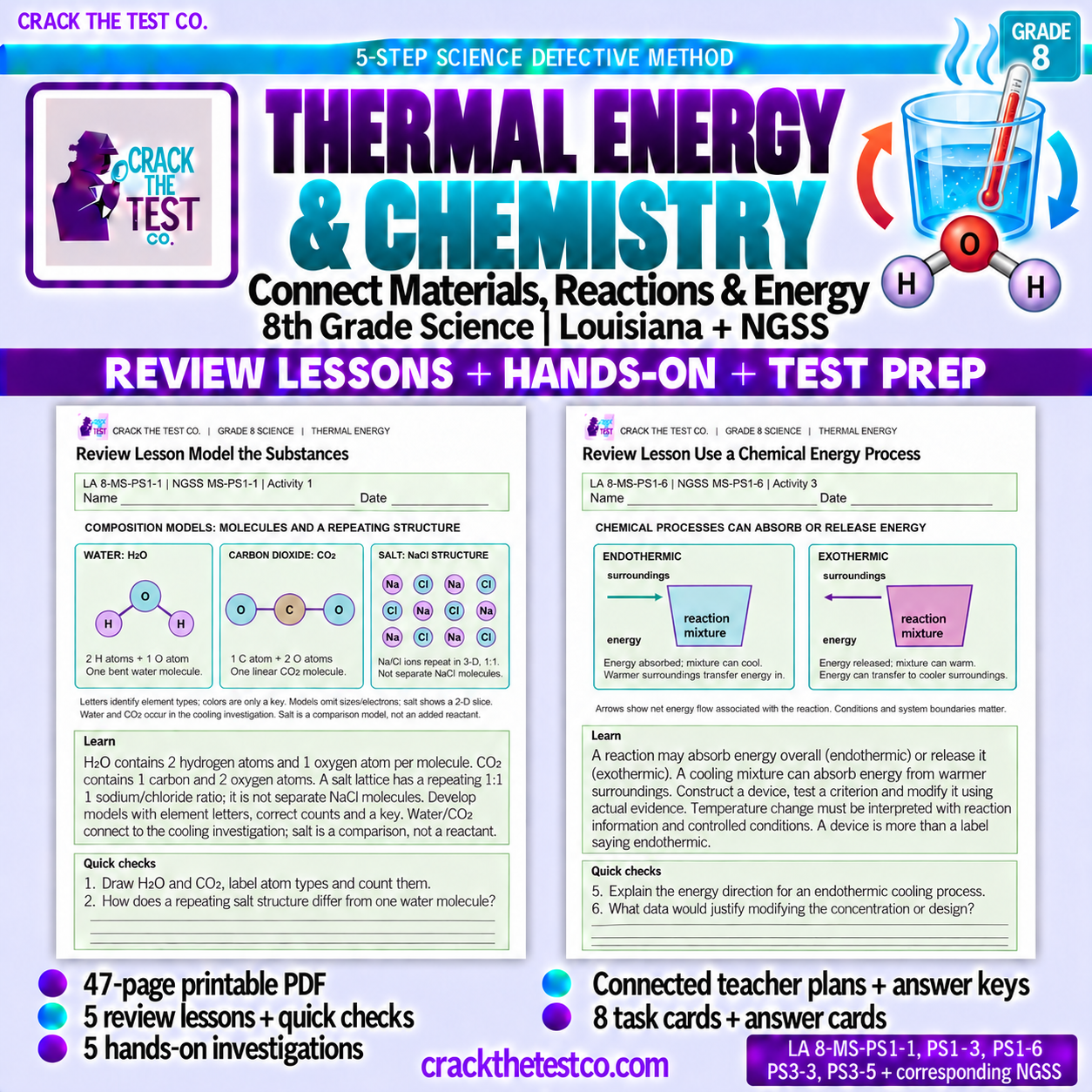
Five illustrated student review lessons provide ten quick checks of understanding before test prep to help teachers identify misconceptions and improve student success.
Included:
- Connected planning sequence, explicit I can targets, standards mapping and readiness checks.
- Teacher plans with questions, expected evidence, misconceptions, reteach/recheck actions, differentiation, discussion, feedback, revision and closure.
- Five review lessons: molecule/extended-structure models, synthetic insulation, chemical heating/cooling, thermal transfer and motion-energy arguments.
- Five linked investigations and recording pages: paper composition models; a source-based material pathway/impact investigation; construction/testing/modification of an open chemical cooling prototype; construction and controlled retesting of an insulating sleeve; and a motion-energy evidence investigation.
- Recognizable labeled composition models, manufacture pathway, energy-flow diagrams, a chemical-device setup diagram and a scaled cooler-performance graph.
- Short source summaries and official teacher-reference links.
- Six multiple-choice questions, one select-two, dependent and independent pairs, a two-point written response, and an original six-point synthesis task, with keys and criteria.
- Eight task cards and matching answer cards.
- Optional six-point digital quiz questions and setup instructions. No premade live Form; writing requires manual scoring.
Standards and scope: Targets Louisiana 8-MS-PS1-1, 8-MS-PS1-3, 8-MS-PS1-6, 8-MS-PS3-3 and 8-MS-PS3-5, with corresponding NGSS standards.
Students develop models, use source information, construct/test/modify devices and argue from evidence. The teacher guidance explains the scope of chemistry in these tasks, including the distinction between describing composition and predicting energy performance. It does not require valence-electron analysis, balancing equations, mole calculations or numerical bond-energy calculations.
This is an independent connected supplement rather than a complete adopted curriculum or official LEAP resource. LDOE crosswalk, July 2026 assessment/Amplify guidance and September 2026 Educator Rubric checked October 28, 2026. The sequence is an instructional design connecting the targeted expectations; it does not claim all five appear in a single Amplify unit column. Rubric-informed opportunities support exemplary practice; ratings depend on observed teaching and student evidence.
Materials and use: Paper models/source work use common supplies and included information. Thermal-device work needs identical cups/lids, water no warmer than 40°C, thermometers, timer, wrap material and trays. Teacher-supervised chemical design uses open plastic cups in stable holders, household 5% white vinegar, water, baking soda, goggles and measuring equipment. The gas-producing reaction must remain open. It is a classroom model, not a medical device or food-storage product.
Teacher pretests and supervises investigations. Actual results vary. Printed evidence-analysis alternatives support access but do not alone demonstrate physical construction/testing expectations. Select review/model/source pages and separate keys when preparing substitute packets; laboratory activities require appropriate preparation and supervision.
Format: Printable PDF. No editable Word template is included in the purchase.
Free companion: Study guides are available separately. Find the FREE one-page Thermal Energy and Chemistry Study Guide at crackthetestco.com. Enter your email to download it, and your code for 10% off a future purchase appears on the download page. The guide is free and is not included inside the paid PDF.