By a 25-Year Louisiana Educator | Crack the Test Co.
Louisiana is making significant changes to its LEAP assessments. While reducing testing time may sound like welcome news to teachers, parents, and students, these changes raise an important question:
If students are no longer tested every year in every subject, how do we ensure they are prepared when those testing years arrive?
After spending 25 years teaching in Louisiana classrooms, I believe the answer lies in something educators have understood for decades: strong foundational instruction, research-based strategies, instructional scaffolding, and consistency across grade levels.
Removing a state assessment does not remove the academic standards students must master.
In fact, Louisiana’s new testing structure makes instructional alignment across grade levels more important than ever.
At a Glance: What’s Changing
This spring (2027), LEAP testing is unchanged. Students in grades 3–8 will still test in ELA, math, science, and social studies.
ELA and Math (Grades 3–8): Still tested every year, with shorter tests since spring 2025.
Social Studies: Starting in 2027–2028, tested only in grades 3, 5, and 8.
Science: Starting in 2027–2028, planned for grades 4 and 7 only.
High School: Students entering ninth grade in 2026–2027 will take one comprehensive ELA exam and one comprehensive math exam at the end of tenth grade.
What’s Changing with Louisiana LEAP Testing?
Louisiana has announced changes affecting all four core subjects. Some reductions have already taken effect, while others will begin during the 2027–2028 school year.
Here’s what parents and teachers need to know.
English Language Arts (ELA)
Grades 3–8 will continue taking annual LEAP assessments.
Beginning in spring 2025, Louisiana reduced ELA testing time by approximately 20%.
Changes included:
- Reducing the number of writing prompts from two to one.
- Shortening testing time by approximately 40–75 minutes, depending on grade level.
- Continuing to assess Louisiana’s academic standards.
High School Changes
Beginning with students entering ninth grade during the 2026–2027 school year, Louisiana is transitioning from separate English I and English II assessments to one comprehensive ELA assessment at the end of tenth grade.
The new assessment structure is expected to begin with that cohort in spring 2028.
Mathematics
Grades 3–8 will continue taking annual LEAP assessments.
Beginning in spring 2025, Louisiana reduced mathematics testing time by approximately 20%.
Changes included:
- Eliminating four machine-scored tasks.
- Eliminating two constructed-response tasks.
- Reducing assessment time by approximately 30–40 minutes, depending on grade level.
High School Changes
Students entering ninth grade during the 2026–2027 school year will transition from separate Algebra I and Geometry assessments to one comprehensive mathematics assessment at the end of tenth grade.
Science
Beginning in the 2027–2028 school year, Louisiana plans to administer statewide science assessments in grades 4 and 7 instead of annually in grades 3–8.
This means:
- Grade 3: No annual statewide science LEAP assessment.
- Grade 4: Statewide science LEAP assessment.
- Grade 5: No annual statewide science LEAP assessment.
- Grade 6: No annual statewide science LEAP assessment.
- Grade 7: Statewide science LEAP assessment.
- Grade 8: No annual statewide science LEAP assessment.
High school science assessments will continue.
Although fewer grade levels will participate in statewide science testing, students must still develop the scientific knowledge and reasoning skills required by Louisiana’s academic standards.
Social Studies
Beginning in the 2027–2028 school year, Louisiana will administer social studies LEAP assessments in grades 3, 5, and 8.
The new assessments will align with Louisiana’s Freedom Framework social studies standards.
Students will be assessed on content learned across multiple grade levels.
- Grade 3: Kindergarten through third-grade content.
- Grade 5: Fourth- and fifth-grade content.
- Grade 8: Sixth- through eighth-grade content.
Grades 4, 6, and 7 will no longer take annual statewide social studies assessments.
However, their academic content will still be assessed in subsequent testing grades.
High school Civics assessments will continue.
What Does This Mean for Parents and Teachers?
Reducing testing time is not necessarily a bad thing.
Teachers need time to teach, and students need opportunities to investigate, explore, discuss, and develop a genuine understanding of academic content.
However, eliminating annual assessments in some grades creates a challenge.
How will schools identify and address learning gaps before students reach the next statewide testing year?
This question takes me back to the beginning of my teaching career.
Lessons from 25 Years in Louisiana Classrooms
When I graduated from college in 2001, Louisiana’s LEAP testing system was becoming a major focus in education.
At the university, we were taught an instructional planning method that shaped my entire career:
Start with the assessment and plan backward.
We learned to identify what students needed to know, determine the skills required for success, and plan instruction accordingly.
We also learned the importance of studying educational research and using that research to guide classroom instruction.
Most importantly, we learned that effective instruction must respond to the individual needs of students.
When I began teaching, I noticed that my students consistently performed well compared to state averages.
Naturally, I wanted to understand why.
As I spoke with other teachers, I discovered that many were continuing to teach in much the same way they had before the increased emphasis on standardized assessments.
I understood their reasoning.
Teachers had established routines and instructional methods they trusted. Changing those practices required time, training, and resources that were not always available.
However, the expectations placed on students had changed.
And I believed our instruction needed to change with them.
When Fourth and Eighth Grades Carried the Pressure
During the early years of my career, fourth and eighth grades were particularly high-stakes testing years.
Students who did not meet promotion requirements could be retained.
Schools spent substantial resources providing summer remediation programs for students who failed to meet those expectations.
I witnessed students becoming significantly older than their classmates because they had been retained.
I also witnessed students entering testing grades with learning gaps that had developed over several years.
Some students struggled with foundational reading skills. Others had difficulty with basic mathematical concepts, interpreting questions, or explaining their reasoning.
Many students also faced difficult circumstances outside the classroom that affected their ability to learn.
As teachers, we were expected to address these challenges while ensuring students mastered increasingly demanding academic standards.
And I began recognizing a serious problem.
We were often waiting until students reached a tested grade to address learning gaps that had developed years earlier.
By that point, students were expected to master new grade-level material while simultaneously overcoming weaknesses in foundational skills.
That is an enormous challenge for both students and teachers.
As Louisiana expanded statewide testing across grades 3–8, schools gained additional opportunities to monitor academic performance.
But testing alone was never going to solve the underlying problem.
What mattered was how teachers used assessment information to guide instruction.
Why Every Grade Matters
Throughout my career, I taught multiple subjects across several grade levels.
Because my teaching qualifications allowed me to work across a wide range of grades and content areas, I had an opportunity to observe how academic skills developed over time.
I also saw what happened when those skills were not mastered.
A student who struggled with reading comprehension in elementary school often encountered even greater difficulty interpreting complex informational texts in middle school.
A student who lacked foundational mathematical understanding could struggle when expected to apply those concepts to increasingly complex problems.
And students who had not learned to analyze evidence, interpret sources, or explain their reasoning often struggled when those skills became essential to success.
The subject changed.
The grade level changed.
But the underlying academic weaknesses frequently remained.
Students do not suddenly develop grade-level mastery simply because they have advanced to the next grade.
That is why I believe effective instructional strategies should be introduced early, reinforced consistently, and adapted as students progress through school.
And that belief is supported by educational research.
What Peer-Reviewed Research Tells Us About Scaffolding and Learning Strategies
Two peer-reviewed studies that influenced the development of my instructional program were van de Pol, Volman, and Beishuizen (2010) and Donker and colleagues (2014).
I studied both and applied their principles in my classroom.
Instructional Scaffolding: Meeting Students Where They Are
Van de Pol, Volman, and Beishuizen (2010), in their research review Scaffolding in Teacher–Student Interaction: A Decade of Research, examined how teachers provide instructional support to students.
Their research identified three important characteristics of scaffolding:
- Contingency: Adjusting instructional support according to students’ individual needs.
- Fading: Gradually reducing support as students develop greater understanding and independence.
- Transfer of responsibility: Helping students assume greater responsibility for their own learning.
These principles became fundamental to my instructional approach.
When students entered my classroom performing below grade level, I could not simply ignore their learning gaps and continue teaching as though everyone had mastered the previous year’s content.
But I also could not abandon grade-level expectations.
Instead, I needed to identify the barriers preventing students from succeeding and provide the instructional support necessary to help them move forward.
Scaffolding does not mean lowering academic expectations. It means providing appropriate support so students can work toward meeting those expectations.
Teaching Students How to Think About Their Thinking
Donker and colleagues (2014), in Effectiveness of Learning Strategy Instruction on Academic Performance: A Meta-analysis, examined 58 studies involving learning strategy instruction.
Their findings indicated that explicitly teaching students learning strategies can improve academic performance, although the effectiveness of individual strategies varies across subjects.
The researchers also identified the importance of teaching metacognitive knowledge.
Metacognition involves students becoming aware of and learning to monitor their own thinking.
This has important classroom implications.
Students need more than factual knowledge.
They also need to learn how to approach unfamiliar questions, recognize when they are confused, evaluate information, and determine whether their answers are supported by evidence.
These research findings helped reinforce my belief that learning strategies should be explicitly taught rather than simply expected.
However, strategies must be appropriate to the content being taught. A consistent approach to reasoning should support subject-specific instruction, not replace it.
How I Used Research to Build My Instructional Program
I did not simply read educational research and file it away.
I used it.
Throughout my teaching career, I developed an instructional system that combined standards-aligned test preparation, analysis of student responses, targeted mini-lessons, scaffolding, and student accountability.
The process began with assessment.
When students completed test-preparation assignments, I did not simply record their scores and move on.
I examined their responses to determine what was preventing them from succeeding.
Why did the student miss the question?
Was the problem a lack of content knowledge?
Was the student missing a foundational skill?
Did the student misunderstand what the question was asking?
Did the student struggle to identify supporting evidence?
Or did the student understand the content but lack an effective strategy for applying that knowledge?
These distinctions were important.
Two students could answer the same question incorrectly for entirely different reasons.
Giving both students the same additional worksheet would not necessarily address either student’s actual learning needs.
Targeted Mini-Lessons: Addressing the Real Problem
Once I identified the obstacles preventing student success, I developed targeted mini-lessons.
Some students needed foundational instruction.
Others needed explicit modeling, additional guided practice, or instruction in applying a particular reasoning strategy.
I used scaffolding to provide appropriate support while maintaining grade-level expectations.
The objective was to help students develop the skills necessary to approach similar problems with increasing independence.
The assessment identified the problem. The mini-lesson addressed the problem. Scaffolding provided the support students needed to move forward.
This was not simply test preparation.
It was using assessment results to guide instruction.
And it became an essential part of my classroom teaching system.
Accountability: Why I Assigned Two Separate Grades
Another component that I found paramount to the success of my instructional program was student accountability.
I discovered that teaching students effective strategies was not enough.
Students needed to understand that applying those strategies was an academic expectation.
To reinforce this, I assigned two separate grades for test-preparation assignments.
Grade 1: Academic Content
The first grade reflected students’ performance on the actual assessment questions.
This allowed me to evaluate their understanding of the academic content and identify areas where additional instruction was needed.
Grade 2: Application of Strategies
The second grade reflected students’ use of the learning and problem-solving strategies they had been explicitly taught.
Students were accountable for demonstrating their reasoning processes, not simply selecting an answer.
This distinction was particularly important for students performing below grade level.
A student might answer a question incorrectly while demonstrating meaningful progress in applying a newly learned strategy.
That student still needed additional content instruction, but I could recognize the successful application of the strategy.
Likewise, a student might select the correct answer without demonstrating the reasoning processes we were practicing.
By assessing content knowledge and strategy application separately, I reinforced both expectations.
Students were accountable for what they knew and how they applied the strategies they had learned.
This system also provided additional information to guide my instruction.
Was the student struggling because of missing academic knowledge?
Or did the student need more instruction in applying the strategy?
Separating these two components helped me make more informed instructional decisions.
The value of this particular grading approach reflects my classroom experience. While educational research supports explicit strategy instruction and scaffolding, the effectiveness of assigning two separate grades would require additional research to establish independently.
For my students, however, accountability was an essential component of the instructional system I developed.
Why Schools Need Consistent Strategies Across Grade Levels
Now imagine what could happen if students encountered familiar instructional strategies throughout their education.
A third-grade teacher explicitly teaches students how to analyze questions, identify important information, and support their answers.
In fourth grade, those strategies are reinforced while students encounter more challenging academic content.
In fifth grade, students apply familiar reasoning processes to increasingly complex tasks.
By middle school, students have practiced many of these processes repeatedly while developing the ability to apply them more independently.
The content becomes more challenging.
The academic expectations increase.
But students are not continually starting over with unfamiliar instructional routines.
This does not mean every teacher must teach exactly alike.
Teachers need flexibility to respond to the students in their classrooms.
Nor does it mean every subject should use identical strategies for every task.
Instead, I believe schools benefit from shared academic expectations, consistent instructional language, and coordinated approaches to teaching transferable reasoning skills.
Research supports explicit learning strategy instruction and appropriately adjusted scaffolding. Establishing that a particular schoolwide strategy system improves achievement would require direct evaluation of that system.
Nevertheless, instructional continuity offers a practical framework for helping students build on what they have previously learned.
And with Louisiana moving toward fewer statewide assessments in science and social studies, this is an opportunity worth considering.
Why I Created Crack the Test Co.
There were many years when 16-hour workdays were not unusual for me.
Not because I believed teachers should be expected to work those hours, but because developing effective lessons, assessments, instructional strategies, and interventions required time.
I spent years studying research, evaluating student performance, and refining instructional approaches.
I worked to understand why students struggled and what I could do differently to help them succeed.
Over time, those experiences helped me develop a structured instructional system.
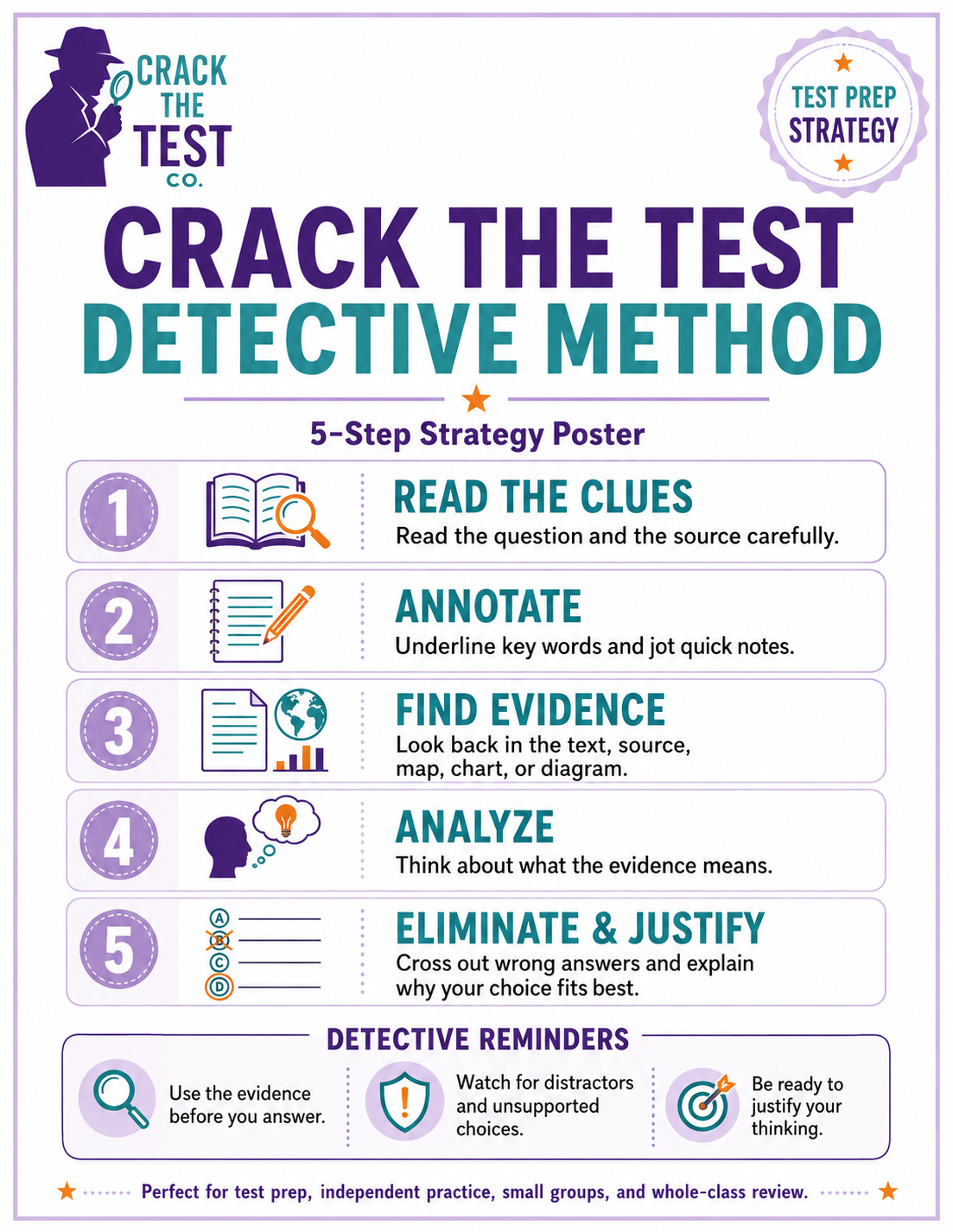
One component was my Crack the Test Detective Method, designed to guide students through a consistent process for examining questions, identifying important information, evaluating evidence, and developing supported answers.
My goal was never simply to teach students how to pass a test.
It was to help them develop the knowledge, reasoning skills, and academic independence necessary to succeed.
After 25 years in education, I did not want those lessons to disappear.
That is why I created Crack the Test Co.
My mission is to provide teachers with practical, standards-aligned instructional resources built around the principles of effective instruction, scaffolding, consistent learning strategies, and meaningful assessment.
The resources are designed to go beyond traditional test-preparation worksheets.
They incorporate instructional guidance, structured strategies, different question formats, and opportunities for teachers to identify areas where students may need additional support.
I want teachers to have access to instructional tools and approaches that took me years to develop.
And I want students to become confident in their ability to approach challenging academic tasks.
Less Testing Should Not Mean Less Preparation
Louisiana’s decision to reduce statewide testing does not have to represent a step backward.
In fact, it could become an opportunity to move forward.
But that will require schools to think beyond individual testing years.
A fourth-grade student who is no longer required to take an annual social studies LEAP assessment will still need fourth-grade knowledge to succeed on the fifth-grade assessment.
A sixth-grade student who does not take an annual science LEAP assessment still needs to develop the knowledge and skills required for continued success in science.
And students who enter middle school with unresolved foundational weaknesses still need targeted instruction and support.
The absence of a state assessment does not eliminate the responsibility to monitor student learning.
Nor does it eliminate the importance of teaching students how to demonstrate what they know.
We cannot expect students to demonstrate eighth-grade mastery if we have not addressed the learning gaps they developed in earlier grades.
Rather than waiting until a tested grade to identify academic weaknesses, schools have an opportunity to strengthen instructional continuity throughout a student’s education.
Teachers can collaborate across grade levels, reinforce effective academic strategies, and use classroom assessments to identify learning gaps before they become more difficult to address.
Parents can support this process by understanding what their children are expected to learn each year, even when that grade does not have a statewide assessment.
And students can benefit from learning strategies that become increasingly familiar as they progress through school.
After 25 years in Louisiana classrooms, one belief remains central to my educational philosophy:
Every grade prepares students for the next. Every subject contributes to academic development. Every year matters.
Louisiana may be reducing the number of LEAP assessments, but we should never reduce our commitment to preparing students for academic success.
Free Resources for Your Classroom
Want to bring the Crack the Test Detective Method into your classroom? Download the free 5-step strategy poster, available in both letter size and 11×17 classroom size, and give your students a consistent process for tackling any test question. When you join our email list, you’ll also receive a 10% welcome discount on your first purchase.
👉 Download your free Detective Method poster
About Crack the Test Co.
Crack the Test Co. was founded by a veteran Louisiana educator with 25 years of classroom experience and a master’s degree in Educational Leadership.
Our mission is to help teachers provide meaningful, standards-aligned instruction while equipping students with consistent strategies for approaching challenging academic tasks.
Through our Crack the Test Detective Method and instructional resources, we aim to make effective test preparation a natural extension of classroom learning.
Because great test preparation begins with great instruction.
Visit crackthetestco.com to explore our instructional resources.
References and Further Reading
Peer-Reviewed Educational Research
van de Pol, J., Volman, M., & Beishuizen, J. (2010). Scaffolding in teacher–student interaction: A decade of research. Educational Psychology Review, 22, 271–296. https://doi.org/10.1007/s10648-010-9127-6
Donker, A. S., de Boer, H., Kostons, D., Dignath van Ewijk, C. C., & van der Werf, M. P. C. (2014). Effectiveness of learning strategy instruction on academic performance: A meta-analysis. Educational Research Review, 11, 1–26. https://doi.org/10.1016/j.edurev.2013.11.002
Louisiana Department of Education and BESE Sources
Louisiana Department of Education. (2024, October 9). Louisiana reduces time students spend testing. https://doe.louisiana.gov/about/news-releases/release/2024/10/09/louisiana-reduces-time-students-spend-testing
Louisiana Department of Education. (2025, March 17). Louisiana makes additional reductions to student testing. https://doe.louisiana.gov/about/news-releases/release/2025/03/17/louisiana-makes-additional-reductions-to-student-testing
Louisiana Department of Education. (2025, October 15). Louisiana reduces state testing for high school students. https://doe.louisiana.gov/about/news-releases/release/2025/10/15/louisiana-reduces-state-testing-for-high-school-students
Louisiana Board of Elementary and Secondary Education. (2026). Rulemaking docket: Bulletin 118, Statewide Assessment Standards and Practices. Science assessment changes effective beginning in 2027–2028. https://bese.louisiana.gov/policy/rulemaking-docket
Testing information reviewed October 20, 2026. Families and educators should consult the Louisiana Department of Education for any subsequent changes to statewide assessment requirements.
Leave a Reply